

Stress-Free Business Travel Tips for 2026


Table of Contents
- Pre-Trip Planning: The Foundation of Stress-Free Business Travel
- How to Pack for a Business Trip Efficiently
- Corporate Travel Management Best Practices for Teams
- Business Travel Productivity Hacks That Protect Your Schedule
- Private Chauffeur Benefits for Business Travelers
- Traveler Wellness: Hydration, Jet Lag, and Mental Health on the Road
- Conclusion: Building a Stress-Free Business Travel Routine
- Frequently Asked Questions
Last Updated: September 18, 2026
Pre-Trip Planning: The Foundation of Stress-Free Business Travel
Stress-free business travel starts with a repeatable pre-trip routine that removes decisions from the day of departure. Travelers who plan ahead arrive calm; travelers who improvise arrive frazzled. Build the routine once, then reuse it.
Building a Repeatable Pre-Trip Checklist
An effective pre-trip checklist covers bookings, documents, packing, and ground transportation. Run it 48 hours before departure, then again the night before.
- Confirm flight times and check in online as soon as the window opens
- Verify hotel reservation and save the confirmation offline
- Check your ID or passport expiration date
- Confirm your airport pickup and share your flight number with the provider
- Charge phone, laptop, and portable charger
- Check the weather at your destination
Managing Travel Documents and Digital Organization
Travel documents are the one category you cannot afford to improvise. Keep digital copies of your ID, passport, itinerary, and travel insurance policy in a secure offline folder, plus physical backups in a separate bag. Create a phone folder per trip, named by date and destination, holding confirmations, addresses, and contact numbers.
Photograph the front and back of every card you travel with and store the images in an encrypted folder. If a wallet goes missing, you can call every issuer the same day instead of reconstructing your accounts from memory.
How to Pack for a Business Trip Efficiently
Efficient packing means one carry-on bag, a capsule wardrobe, and a reusable written packing list. The goal is to eliminate checked-bag risk on trips of three days or fewer.
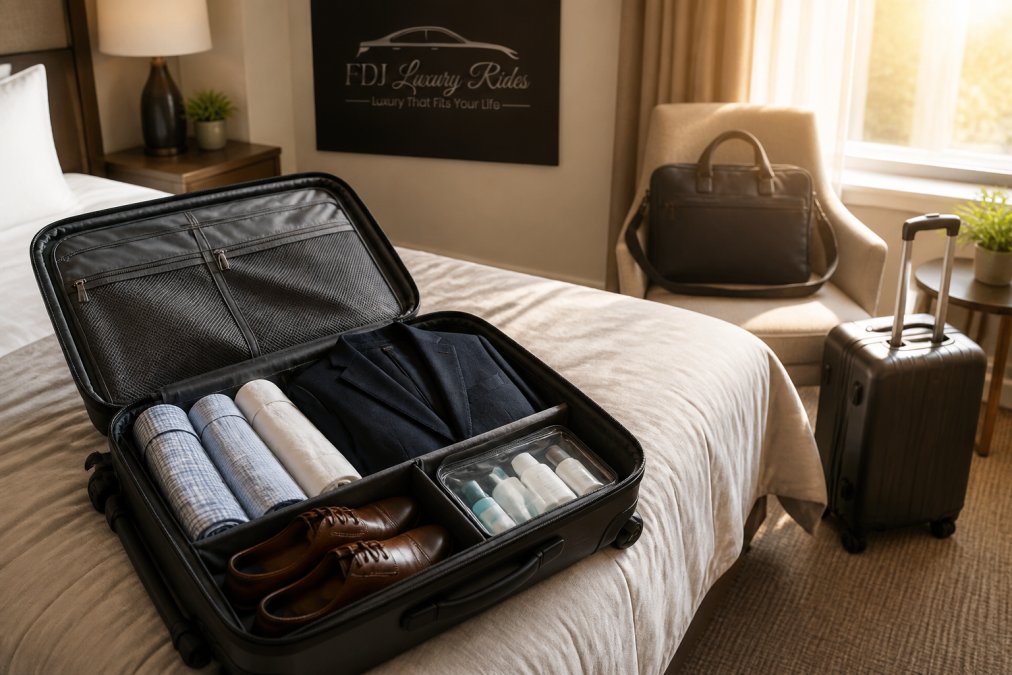
- Clothing: two suits or two blazer-and-trouser combinations, three shirts, one pair of dress shoes, one pair of comfortable shoes
- Essentials: laptop, chargers, portable charger, headphones
- Toiletries: travel-size containers only, in a clear quart bag
- Documents: ID, cards, printed confirmations
Carry-On Only: What to Bring and What to Leave
Bring anything you would struggle to replace within 24 hours: medication, laptop, chargers, one full outfit, and your travel documents. Leave behind the second pair of dress shoes, the extra blazer, and anything packed “just in case.” The rule that works: if you have not used an item on your last two trips, it does not belong in the bag.
Corporate Travel Management Best Practices for Teams
Corporate travel management best practices come down to four things: centralized booking, a clear expensing process, consistent travel insurance coverage, and a data-security policy covering devices and networks on the road. When each traveler books independently, you lose visibility on spend and nobody owns the security question until something goes wrong.
Centralizing Bookings, Expensing, and Travel Insurance
A workable structure looks like this:
| Process | Owner | Frequency | Tool |
|---|---|---|---|
| Booking requests | Travel manager | Per trip | Shared booking log |
| Expense submission | Traveler | Within 5 days | Expense platform |
| Insurance review | Travel manager | Quarterly | Policy file |
| Provider review | Travel manager | Annually | Vendor notes |
| Device and account audit | IT | Quarterly | Device management console |
Set a submission deadline for expenses and stick to it. Receipts collected the same day take seconds to file; receipts reconstructed weeks later take an hour.
Skipping travel insurance to save on a line item is the most expensive shortcut in corporate travel. A single missed connection or medical issue can cost more than a year of coverage, and the traveler, not the company, often absorbs the difference.
Cybersecurity for Travelers: Protecting Company Data on the Road
This is the part most travel policies leave out, and it creates the largest liability. A traveler on a hotel or airport network is a soft target, and the damage is not limited to their own device.
- Require a VPN on any network the company does not control. Public Wi-Fi is the obvious case, but hotel and conference networks count too.
- Turn on full-disk encryption and a screen lock on every laptop and phone. If a device is lost, encryption is the difference between an inconvenience and a breach.
- Use a password manager and unique credentials for every work account. Reused passwords are how one compromised travel booking turns into a compromised email account.
- Keep work data off personal cloud accounts. A traveler syncing a client file to a personal drive to “have it handy” has just moved company data outside the company’s control.
- Enable multi-factor authentication everywhere it is offered. This is the single highest-return setting on the list.
- Have a lost-device procedure. Who the traveler calls, what gets wiped remotely, and how fast. Write it down before anyone needs it.
Duty of Care: Knowing Where Your People Are
Duty of care is the legal and practical obligation to know where your travelers are and reach them in an emergency. It sounds bureaucratic until a storm grounds flights and you cannot answer “who is where right now?” Three things make it real:
- A live itinerary. Every traveler’s flights, hotels, and ground transportation in one place, updated when plans change.
- A check-in protocol. A simple message when a traveler lands and when they reach the hotel. Two lines, sent by the traveler, received by the manager.
- A named point of contact. One person the traveler calls when something goes wrong, and one person who calls them when something goes wrong at home.
Business Travel Productivity Hacks That Protect Your Schedule
Business travel productivity hacks work by protecting two things: your energy and your calendar. Effective travelers are not working more hours; they defend the hours that matter.
Time Zone Management and Remote Work Routines
Time zone management starts before departure. Flying east, shift your bedtime earlier by an hour a night for two or three nights; flying west, do the opposite. Once you land, anchor your day to local time: eat at local hours, get outside in daylight, and avoid long naps. For remote work, set fixed call windows that overlap with your home office and protect the rest of the day for focused work.
The travelers who beat jet lag are the ones who stop negotiating with their body clock. Adopt local time on arrival, and the adjustment takes days instead of a week.
Private Chauffeur Benefits for Business Travelers
As one client put it:
“Franklin is so extremely professional and personable. It’s wonderful to arrive at the airport and not worry about finding transportation or driving home.” — Peggy Horne
Traveler Wellness: Hydration, Jet Lag, and Mental Health on the Road
Traveler wellness is the most neglected part of business travel, and where stress accumulates fastest. Hydration, sleep, and mental health on the road determine whether you perform in the meeting you flew across the country to attend. The harder problem is the cumulative psychological toll of frequent travel, and that is worth building a system around.
Hydration and Jet Lag: The Physical Baseline
Start with hydration. Cabin air is dry, and caffeine and alcohol make it worse. Carry a refillable bottle and drink water consistently through the flight rather than in one burst.
Mental Health and Burnout Prevention on the Road
Business travel isolates people, and the isolation is easy to miss because it looks like productivity: a hotel room, a laptop, no interruptions. Over months, that pattern produces burnout that shows up as cynicism about trips you used to enjoy, dread before departure, and a growing inability to focus on the road.
Watch for these warning signs:
- You stop planning anything outside the hotel and the meeting room
- You skip meals or eat only at the hotel because leaving feels like effort
- You feel relief, not accomplishment, when a trip is canceled
- You sleep poorly even when you have the time to sleep
Keep a running note on your phone titled “Next Trip.” Every time something goes wrong, add one line. After three or four trips, that note becomes a personalized checklist better than any generic guide, and it doubles as a record of what actually stresses you out on the road.
Post-Trip Recovery Protocols
Post-trip recovery is the step almost everyone skips. Block the morning after a return flight for light work only, and avoid back-to-back meetings on your first day back.
A simple protocol:
- Get outside in daylight within an hour of waking
- Return to your normal sleep schedule the first night, even if you are tired
- Clear your inbox in one focused session rather than all day
- Review what went wrong on the trip and update your checklist
Conclusion: Building a Stress-Free Business Travel Routine
The challenge with business travel is not any single trip; it is the cumulative wear of doing the same avoidable tasks badly, over and over. The fix is a routine: a checklist you reuse, a packing system that fits in one bag, and ground transportation you never have to think about.
Frequently Asked Questions
What should be included in a stress-free business travel checklist?
A solid checklist covers travel documents (passport, ID, Global Entry card), digital backups of reservations, a carry-on packing list built around one or two outfits, portable charger and cables, essential toiletries in TSA-approved sizes, and confirmed ground transportation. Add your loyalty program numbers, corporate travel policy details, and travel insurance information. Review it 48 hours before departure so you have time to fix anything missing without scrambling at the airport.
How can I maintain a productive routine while traveling for business?
Anchor your day with two or three non-negotiable habits: a morning planning block, a set time to clear email, and a wind-down routine before bed. Use online check-in and pre-scheduled ground transportation to reclaim time you would otherwise spend waiting. Block focus hours on your calendar just as you would at the office, and keep a portable charger on hand so a low battery never cuts a work session short. Small consistencies protect professional productivity better than trying to replicate your entire home schedule.
How does professional chauffeur service improve business travel efficiency?
A private chauffeur removes the uncertainty of finding a ride after landing. Real-time flight tracking means your driver adjusts when your flight is delayed, so there is no waiting or rebooking. You get a quiet, private vehicle to take calls or review documents between the airport and your meeting. For corporate travel managers coordinating multiple executives, a chauffeur service handles scheduling and logistics in one booking, which cuts the coordination burden on your team.
How can I manage time zone changes effectively during corporate trips?
Shift your sleep schedule by an hour or two in the days before departure. Set your watch to the destination time as soon as you board, and use that as your cue for when to sleep and when to stay awake. Get sunlight early in the morning at your destination to help reset your body clock. Avoid heavy meals and alcohol on the flight, and drink more water than you think you need. A consistent travel routine makes each subsequent trip easier.
What are the best ways to minimize travel fatigue on long trips?
Hydration and movement matter most. Drink water throughout the flight, stand and stretch every hour or two, and wear compression socks on longer routes. Keep your carry-on light so you are not wrestling bags through transit. Book ground transportation in advance so you are not navigating unfamiliar options while exhausted. If your schedule allows, build a buffer day before high-stakes meetings. These habits reduce travel fatigue and help you arrive ready to work.
What are the essential safety precautions for solo business travelers?
Share your itinerary with someone at home or your corporate travel manager. Keep digital and physical copies of travel documents separate. Use a VPN on public Wi-Fi, and avoid discussing sensitive business details in shared spaces. Pre-arrange your airport transfer through a licensed, insured provider so you are not choosing a ride in an unfamiliar city at night. Trust your instincts about any situation that feels off, and have your hotel’s front desk number saved before you arrive.