

Managing Group Transportation for Corporate Events

Table of Contents
- Why Managing Group Transportation for Corporate Events Matters
- Your Corporate Event Transportation Logistics Checklist
- How to Choose a Corporate Transportation Provider
- Managing VIP Transportation for Corporate Retreats
- Technology Integration and Real-Time Tracking for Group Transportation
- Crisis Management and Contingency Planning for Corporate Events
- Accessibility Compliance and Sustainability in Group Transportation
- Conclusion: Mastering Group Transportation for Corporate Events
- Frequently Asked Questions
Last Updated: September 16, 2026
Why Managing Group Transportation for Corporate Events Matters
Managing group transportation for corporate events is the discipline of moving attendees, executives, and VIP guests between airports, hotels, and venues on a coordinated schedule without losing time, money, or goodwill. At FDJ Luxury Rides, we’ve watched too many planners treat it as an afterthought, then scramble when a single vehicle falls through. The stakes are higher than most people assume: when ground transportation fails, the entire event agenda slips, and the people affected are often the ones whose opinion of your company matters most.
Corporate event transportation logistics sit at the intersection of scheduling, budgeting, and risk. Unlike booking a single car, group transportation requires fleet capacity planning, multi-vehicle coordination, and a passenger manifest that accounts for every attendee. Miss one variable and you’re fielding calls from a hotel lobby at 6 a.m.
The U.S. Department of Transportation oversees the federal framework that commercial operators must follow, which is why choosing a licensed, insured provider is not a formality. It’s the foundation everything else rests on. Get the logistics right and your event runs on rails. Get them wrong and no amount of good catering will save the day.
Your Corporate Event Transportation Logistics Checklist
A corporate event transportation logistics checklist is a written plan covering every vehicle, route, timing window, and contingency your event requires.
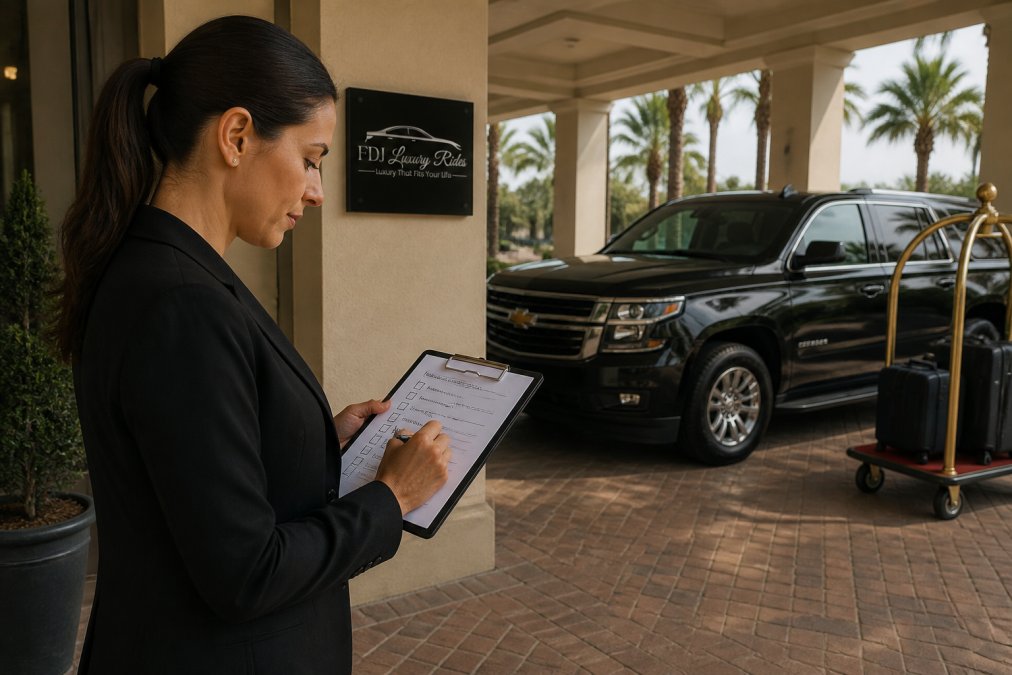
Here’s the sequence that holds up under pressure:
- Confirm attendee count, arrival windows, and departure times, with a 10% buffer for late additions
- Map every route: airport to hotel, hotel to venue, venue to dinner, plus return legs
- Define fleet capacity and vehicle types needed per route, matched to group size
- Build a passenger manifest with names, flight numbers, mobile contacts, and hotel assignments
- Set staggered arrivals so you’re not moving 200 people at once
- Assign an on-site coordinator and a backup, with authority to reassign vehicles
- Confirm booking lead time with your provider, larger events need more runway
- Document safety protocols, insurance certificates, and vehicle maintenance records
- Walk every venue’s loading zone in advance to confirm where vehicles can stage
Build your manifest with mobile numbers, not just names. When a flight is delayed, a text to the right passenger beats a group announcement every time.
Lead time scales with complexity. A single executive pickup can be booked days ahead. A multi-vehicle event with airport transfers, venue movements, and a dinner program needs weeks, not days, to lock in fleet capacity and driver assignments. Ask your provider for their minimum lead time for your specific vehicle count, and build in a cushion for the inevitable last-minute additions.
How to Choose a Corporate Transportation Provider
Choosing a corporate transportation provider comes down to four things: licensing and insurance, fleet capacity, real-time communication, and a track record you can verify. Price matters, but it should never be the first filter. The providers who fail at corporate events are rarely the cheapest ones, they’re the ones who looked qualified on paper and couldn’t scale when the event grew.
Ask these questions before you commit:
- Are you fully licensed and commercially insured? Ask for the certificate of insurance and the operating authority number, not a verbal yes. Verify the coverage limits match your event’s risk.
- Can you coordinate multiple vehicles simultaneously? A provider built for single rides will struggle with a 12-vehicle event. Ask how many vehicles they can commit to on your event date, and whether that commitment is in writing.
- How do you handle flight delays? The answer should involve real-time flight tracking that automatically adjusts pickup times, not a phone call to the driver. Ask to see the tracking dashboard or a sample notification.
- Who is my point of contact on event day? You want a named transportation program manager, not a general dispatch line. Get their mobile number and confirm they’ll be reachable during your event window.
- What does your vehicle maintenance schedule look like? Clean interiors and current service records signal how the operator runs everything else. Ask for the maintenance log for the vehicles assigned to your event.
- What is your backup plan for a vehicle failure? The answer should name the number of backup vehicles available in your area and the response time commitment. “We’ll find one” is not a plan.
- How do you handle accessibility requests? Ask which vehicles accommodate mobility devices and how far in advance you need to request them.
Managing VIP Transportation for Corporate Retreats
Managing VIP transportation for corporate retreats requires a different standard than general attendee movement. Executives expect discretion, punctuality, and a vehicle that reflects the company they represent. This is executive travel, and it should feel like it.
Technology Integration and Real-Time Tracking for Group Transportation
The most useful integration points are straightforward:
- Real-time flight tracking that adjusts pickup times automatically when a flight is early or late
- A shared dashboard showing every vehicle’s position across your event
- Automated passenger notifications with driver name and vehicle details
- Digital manifests that update as attendees confirm or change plans
The value of real-time tracking isn’t surveillance. It’s the ability to make a decision in five minutes instead of thirty, before a small delay becomes a missed keynote.
For multi-vehicle coordination, tracking is what keeps a fleet behaving like one unit. Without it, you’re managing a dozen independent drivers and hoping they align.
Crisis Management and Contingency Planning for Corporate Events
Contingency planning is the part of group transportation most planners skip, and it’s the part that determines whether a bad day becomes a disaster. A vehicle breaks down. A driver gets stuck in traffic. A flight diverts. Each has a plan, or each has a crisis.
Build your contingency plan around three scenarios:
- Vehicle failure: Confirm your provider has backup vehicles available, not just a promise to “find one.”
- Driver delay: Ask how the operator reassigns a ride when a driver is blocked, and whether a second driver can be dispatched.
- Schedule slip: Decide in advance which movements are fixed and which can flex if the event runs long.
Accessibility Compliance and Sustainability in Group Transportation
Accessibility and sustainability are the two areas where group transportation planning most often falls short, and both are increasingly expected rather than optional.
Conclusion: Mastering Group Transportation for Corporate Events
The hardest part of corporate event transportation isn’t any single booking. It’s holding every moving piece together when one of them slips, and doing it without the attendees ever noticing. That requires a provider who treats coordination, contingency, and communication as the core service, not the extras.
Frequently Asked Questions
What are the key components of a corporate event transportation plan?
A solid plan covers several essentials: a detailed passenger manifest with arrival and departure times, vehicle assignments by group size, a clear itinerary with buffer times, contingency routes for traffic or weather, and a single point of contact for on-site coordination. You’ll also want to confirm insurance and licensing, set a booking lead time, and establish communication protocols with your provider. Reviewing these components early prevents last-minute scrambling and keeps your group transportation running smoothly.
How do you coordinate transportation for large groups at corporate events?
Start by breaking your group into smaller clusters based on arrival windows, hotel locations, or role. Assign each cluster a specific vehicle and pickup time, then share a master schedule with all attendees. Use a passenger manifest to track who is on which vehicle, and designate an on-site coordinator to handle real-time adjustments. For multi-vehicle movements, stagger departures and confirm routing with your provider in advance to avoid congestion at venues.
What should be included in a corporate transportation contract?
Your contract should spell out the scope of service, including vehicle types, capacity, and hourly or daily rates. Include cancellation policies, overtime charges, and wait-time rules. Confirm that the provider carries commercial insurance and proper licensing, and ask about driver vetting and vehicle maintenance schedules. Also clarify how changes or additions are handled, who your account manager is, and what backup plans exist if a vehicle breaks down. A clear contract protects both your company and your attendees.
How do you manage VIP transportation logistics for business retreats?
VIP logistics require extra attention to privacy, timing, and comfort. Assign a dedicated vehicle and professional chauffeur to each VIP or small group, and build in buffer time for unplanned requests. Use real-time flight tracking to adjust pickups automatically. Keep a separate manifest for VIPs with their preferences and contact details, and brief your on-site coordinator on any special requirements. Always have a backup vehicle on standby in case of last-minute changes.
What are the benefits of using private chauffeur services for corporate events?
Private chauffeur services offer consistency, safety, and a professional image. Unlike rideshare, you get a dedicated driver who knows your schedule and can adapt to changes. Vehicles are meticulously maintained and commercially insured, and drivers are vetted for professionalism. This reduces stress for attendees and ensures on-time arrivals for meetings or flights. For executive travel and client entertainment, a private service also reflects positively on your company’s attention to detail.
How far in advance should I book group transportation for a corporate event?
For large events or peak seasons, book at least four to six weeks in advance to secure the vehicles and drivers you need. Smaller groups may only need two to three weeks. If your event falls during a major convention or holiday period, lock in your reservation even earlier. Early booking also gives you time to finalize your itinerary, confirm passenger counts, and negotiate contract terms without pressure.
What technology can help with real-time tracking of group transportation?
Many providers offer GPS tracking through a mobile app or web portal, letting you see vehicle locations and estimated arrival times. Some systems integrate with flight tracking to adjust pickups automatically. You can also use shared calendars or messaging apps to keep your team informed. Ask your provider what tracking tools they offer and whether they can send automated updates to attendees. Real-time visibility helps you manage delays and communicate proactively.