

How to Manage Luggage for Large Group Airport Transfers


Table of Contents
- Why Luggage Planning Makes or Breaks Large Group Airport Transfers
- Your Group Travel Luggage Checklist: Build It Before You Book
- How to Match Passenger Count and Airport Transfer Vehicle Luggage Capacity
- Oversized Luggage Airport Transfers: Golf Clubs, Strollers, and Mobility Equipment
- Airport Transfer Loading Time for Groups: What to Budget
- Contingency Planning: Delayed Flights, Missing Bags, and Split Arrivals
- Keeping Bags Secure and Accounted For During Group Airport Transfers
- Conclusion: Book Your Group Airport Transfer with Confidence
- Frequently Asked Questions
Last Updated: October 5, 2026
Why Luggage Planning Makes or Breaks Large Group Airport Transfers
The bags are what sink a group airport transfer, not the headcount. A group of eight with twenty-two pieces of luggage will not fit in a vehicle booked for eight passengers, and that gap is where stress, delays, and missed flights begin.
Group airport transfers succeed when someone counts bags before booking, not at the curb. Most groups count people.
Here is the good news: this is a planning problem, and planning problems have checklists.
Below, we break down how to count luggage, match it to the right vehicle, and build a pickup plan that survives a delayed flight or a missing bag.
Your Group Travel Luggage Checklist: Build It Before You Book
A group travel luggage checklist turns guesswork into a number you can hand to a transportation provider. Build it before you book anything, not the night before departure.
Walk through the group and tally every item:
- Checked bags: one per traveler, plus extras for longer trips
- Carry-on bags: one per traveler, usually
- Personal items: purses, briefcases, laptop bags
- Oversized items: golf clubs, strollers, car seats, mobility equipment
Then note the shape, not just the count. Two duffel bags take less trunk space than one hard-shell suitcase of the same volume.
Ask every traveler for a bag count in writing at least a week out. Verbal estimates at the curb run low almost every time, and the gap shows up as a second trip.
The Luggage Inventory Worksheet: Count Bags, Not Just People
Use a simple worksheet before you request quotes. Fill in one row per traveler.
| Traveler | Checked Bags | Carry-Ons | Personal Items | Oversized Items |
|---|---|---|---|---|
| Traveler 1 | 1 | 1 | 1 | 0 |
| Traveler 2 | 2 | 1 | 1 | 1 (golf clubs) |
| Traveler 3 | 1 | 1 | 1 | 1 (stroller) |
| Totals | 4 | 3 | 3 | 2 |
Add the totals into one number: total pieces. That number, not the passenger count, drives your vehicle choice.
How to Match Passenger Count and Airport Transfer Vehicle Luggage Capacity
Airport transfer vehicle luggage capacity is the real constraint, and it rarely matches the seat count. A vehicle with fourteen seats does not hold fourteen large suitcases. Match both numbers before you confirm.
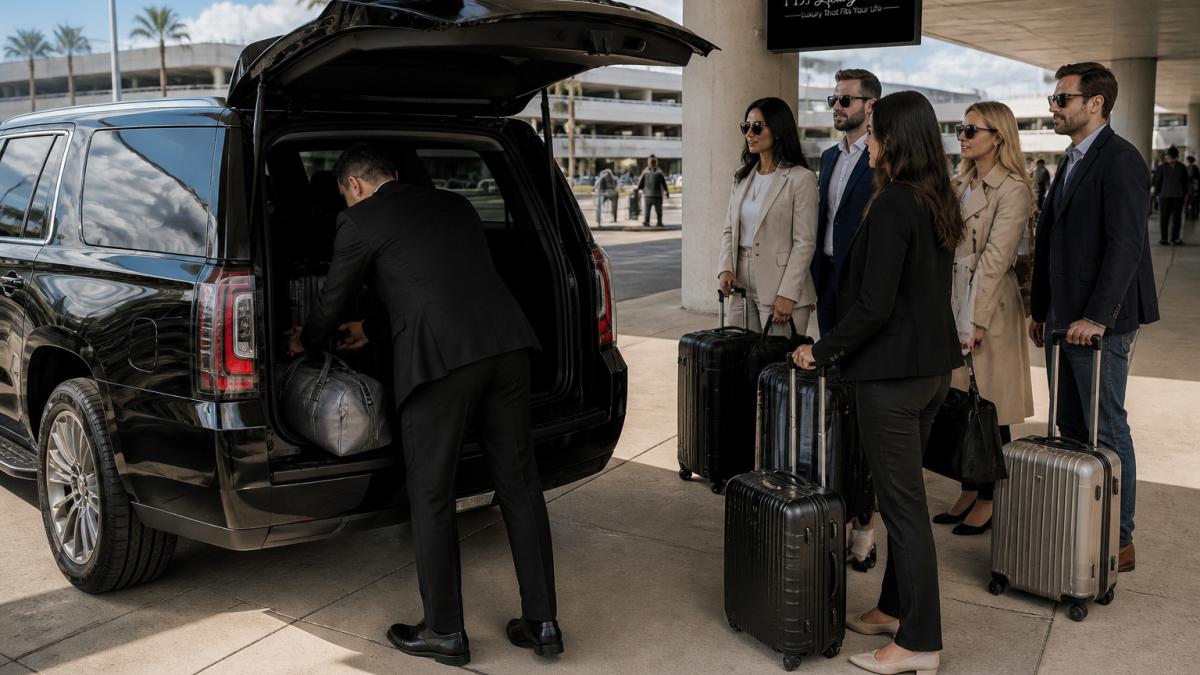
The rule we use: count seats for people, then count trunk space for bags, and treat them as two separate requirements. A full-size SUV typically handles a small group with one checked bag each. Larger groups often need two vehicles rather than one oversized one.
A Practical Capacity Rule of Thumb
Vehicle classes are built around passenger comfort, not luggage volume, so the seat count on the spec sheet overstates what the trunk will actually swallow. A workable planning rule is to assume each full-size checked suitcase consumes roughly the footprint of one seat, and each carry-on or personal item consumes about half a seat’s worth of space.
Use these planning bands as a starting point, then confirm with your provider:
- Sedan (up to 3 passengers): Two to three medium checked bags plus carry-ons. Tight for anything beyond a short trip.
- Full-size SUV (up to 6 passengers): Four to five large checked bags plus carry-ons. Comfortable for a group of four with one bag each.
- Sprinter-style van (up to 14 passengers): Ten to twelve large checked bags when the rear bench is folded or removed. With all seats in use, expect closer to eight.
- Two mid-size SUVs: Roughly double the SUV capacity, but split across two trunks, which changes how you load.
These are planning estimates, not guarantees. Bag shapes, hard-shell versus soft-sided, and whether seats are folded all shift the real number. Always send your worksheet totals to the provider and ask them to confirm the fit in writing.
Why Two Vehicles Sometimes Beat One Big One
Two vehicles give you flexibility a single large one cannot. If one traveler’s flight lands two hours late, the second vehicle can leave with the on-time passengers while the first waits.
Splitting also reduces loading time at the curb, since two trunks fill faster than one. The trade-off is coordination: you now need a group point of contact for each vehicle and a clear plan for who rides where.
There is also a luggage-specific reason to split. A single large vehicle has one trunk, and once it is full, there is no overflow.
Booking one large vehicle to save on coordination sounds efficient until a single delayed flight strands the whole group. Two vehicles absorb that delay without holding everyone hostage.
Oversized Luggage Airport Transfers: Golf Clubs, Strollers, and Mobility Equipment
Oversized luggage airport transfers need advance notice, full stop. Golf clubs, strollers, car seats, and mobility equipment do not fit standard trunk layouts, and a driver who learns about them at pickup cannot fix the problem on the spot.
Tell your provider about every oversized item when you book:
- Golf bags and ski equipment
- Strollers and travel cribs
- Car seats and booster seats
- Wheelchairs, walkers, and mobility scooters
- Musical instruments or display materials for events
Mobility equipment deserves special attention. A folding wheelchair stores differently than a motorized scooter, and both need a vehicle with enough height and floor space. Flag these items early so the right vehicle shows up.
Airport Transfer Loading Time for Groups: What to Budget
Airport transfer loading time for groups runs longer than most people expect. Budget 20 to 45 minutes at the curb for a group of eight or more with checked bags, and build that into your pickup window.
Loading includes more than lifting bags. It includes:
- Gathering the group at one meeting point
- Matching bags to travelers so nothing gets left behind
- Fitting oversized items into the right vehicle
- Confirming every passenger is accounted for before departure
The single biggest variable is not the number of bags, it is whether the group is already assembled when the vehicle arrives. A group that trickles out of baggage claim one at a time can double the loading window. A group that meets at one spot and walks out together cuts it roughly in half.
The Arrival-to-Curb Workflow, Step by Step
Follow this sequence to keep arrival day calm and predictable:
- Track the flight. Real-time flight tracking lets the driver adjust to early or late arrivals.
- Set a meeting point. Pick one spot near baggage claim before travel day. Choose a landmark that does not move, such as a specific carousel or a named seating area, not a gate or a curb lane that changes.
- Allow baggage claim time. Budget 20 to 45 minutes after landing for bags to arrive. International arrivals and larger aircraft tend to run longer.
- Assign a group contact. One person communicates with the driver for everyone. Give that person the driver’s contact info and the vehicle description in advance.
- Stage the bags. Once bags are claimed, move the whole group and all luggage to one staging spot inside the terminal, out of the flow of other travelers, before anyone heads to the curb.
- Load by vehicle. Match bags to the correct vehicle if you are using two. Load large checked bags first, then carry-ons, then personal items, so nothing gets buried.
- Confirm and depart. Count heads and bags before the vehicle pulls away. The group contact does the count against the worksheet, not from memory.
This workflow removes the guesswork that turns a simple pickup into a scramble.
Who Does What: Assigning Roles Before Travel Day
The workflow only works if specific people own specific steps. Before departure, assign:
- A group contact who holds the driver’s number and the master bag count.
- A bag counter who tallies pieces at loading and again at drop-off. This can be the same person as the group contact for small groups, but split the roles once you pass eight travelers.
- A vehicle lead for each vehicle if you are splitting the group, so each load is confirmed independently.
- A straggler watcher who stays with anyone still waiting at baggage claim and texts the group contact when they are moving.
Naming these roles in advance is the difference between a two-minute load and a twenty-minute one. When no one owns the count, bags get left in the terminal and no one notices until the vehicle is on the highway.
The fastest groups are not the ones with the fewest bags. They are the ones where every person knows their job before the plane lands.
Contingency Planning: Delayed Flights, Missing Bags, and Split Arrivals
Contingency planning separates a smooth transfer from a chaotic one. Flights run late, bags go missing, and groups sometimes arrive on three different planes. Plan for all three before travel day.
For delayed flights, real-time flight tracking lets the driver wait without a panicked phone call. For missing bags, designate one traveler to stay behind with the claim while the rest of the group departs, then arrange a follow-up pickup. For split arrivals, assign each traveler to a vehicle in advance so no one is left guessing.
The groups that handle disruption well are the ones that named a point of contact and a backup plan before the trip started. Everything else is improvisation.
Keeping Bags Secure and Accounted For During Group Airport Transfers
Bag security comes down to two habits: one person owns the count, and every bag gets matched to a traveler before the vehicle moves.
Assign a group point of contact who tracks the bag total from curb to destination. Do a quick count at loading and again at drop-off. If a bag is missing, you catch it in minutes instead of hours.
For valuable items, keep them with the traveler in a carry-on rather than in the trunk. For everything else, a simple written count is enough to close the loop.
Conclusion: Book Your Group Airport Transfer with Confidence
Coordinating luggage for a large group is a planning problem, and the fix is a checklist, a bag count, and a provider who plans around volume instead of headcount. Get those three right and arrival day stops being the hard part of the trip.
FDJ Luxury Rides handles this for groups across Florida every week. We offer real-time flight tracking so delays do not derail your pickup, private rides that are never shared, and fully licensed, commercially insured vehicles with professional chauffeurs.
Get started with FDJ Luxury Rides and let us handle the luggage math so your group can focus on the trip.
Frequently Asked Questions
How do you estimate how much luggage a large group will bring?
Ask each traveler to report checked bags, carry-ons, and any special items like golf clubs or strollers. A simple rule: most leisure travelers bring one checked bag and one carry-on, while business travelers often pack lighter. Build your vehicle plan around the highest realistic count, not the average. A shared spreadsheet or group chat poll works well, and it gives your transportation provider the exact numbers they need to assign the right vehicle.
How much extra time should you allow for loading group luggage?
For groups of eight or more with a full load of bags, plan on 20 to 45 minutes from curb arrival to departure. That window covers unloading from baggage claim, sorting bags by vehicle, and secure loading. Add buffer time for traffic and terminal walks. If your group includes oversized items or mobility equipment, lean toward the longer end. A professional chauffeur service can help you build this timing into your pickup window from the start.
What should you do if your group has oversized or special luggage?
Flag oversized items when you book: golf bags, surfboards, strollers, wheelchairs, and musical instruments all take dedicated space. Measure the largest item and share dimensions with your provider so they can confirm vehicle capacity. For mobility equipment, ask whether the vehicle has a lift or ramp and whether the driver can assist with loading. Packing oversized items last, after standard bags are placed, keeps the load stable and speeds up unloading at the terminal.
How can a group keep track of luggage during an airport transfer?
Assign each traveler a numbered tag and a color-coded ribbon, then photograph every bag before loading. Designate one group point of contact who counts bags at pickup and again at drop-off. Keep a written or digital list of tag numbers matched to owners. On multi-vehicle transfers, note which bag went into which vehicle. This takes five minutes and prevents the most common group travel problem: a bag left at the curb or loaded into the wrong car.