

Multi-Vehicle Wedding Logistics: A Planning Guide

Table of Contents
- Why Multi-Vehicle Coordination Matters for Weddings
- Step 1: Assess Your Guest Count and Vehicle Capacity Needs
- Step 2: Build Your Wedding Transportation Timeline
- Step 3: Create a Wedding Transportation Schedule Template
- Step 4: Plan Wedding Guest Transportation Routes and Pickups
- Step 5: Develop Your Wedding Transportation Checklist
- Step 6: Establish Communication and Backup Protocols
- Frequently Asked Questions
Last Updated: October 20, 2026
Why Multi-Vehicle Coordination Matters for Weddings
Coordinating wedding transportation involves more than booking a few cars. With guests arriving from different hotels, a wedding party on separate timing, and family members with special requirements, one delayed pickup can cascade into a late ceremony, and one miscommunication about pickup location can strand guests at the wrong entrance.
At FDJ Luxury Rides, we manage wedding transportation events across Florida.
This guide walks you through building a reliable multi-vehicle wedding logistics plan: capacity planning, scheduling, route mapping, communication, and backups.
Step 1: Assess Your Guest Count and Vehicle Capacity Needs
Start by counting your guests and breaking them into groups, since not all need the same vehicle or pickup time:
- Wedding party (bride, groom, bridesmaids, groomsmen, parents), may need earlier pickups for photos
- Hotel guests, typically depart from one or more hotels at a set time
- Local guests, may drive themselves or need rides from specific addresses
Once you’ve identified your groups, calculate the total passenger count to determine how many vehicles you need and what types.
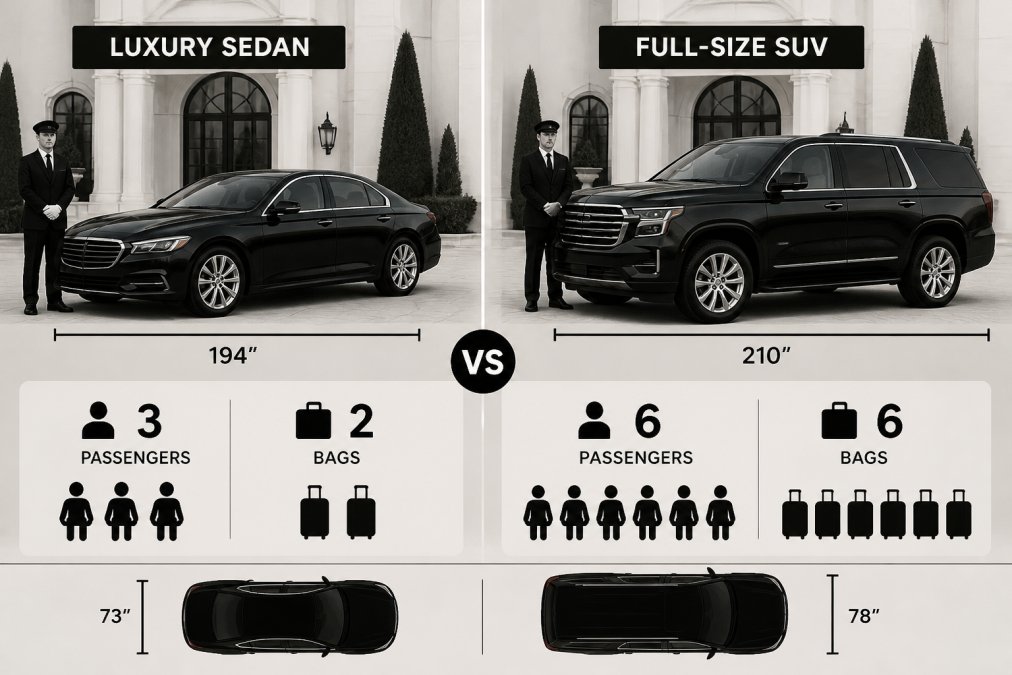
Vehicle capacity guidelines:
- Luxury sedans: 3-4 passengers comfortably
- SUVs: 5-7 passengers
- Executive vans: 8-14 passengers
A common mistake is underestimating vehicle count. If you have 50 guests and think two SUVs will handle it, you’re creating a bottleneck. Oversizing slightly gives you flexibility for late arrivals or last-minute changes.
Build in 20% extra capacity. If your math says you need exactly four vehicles, book five. The extra space absorbs delays, no-shows, and unexpected additions without derailing your timeline.
Step 2: Build Your Wedding Transportation Timeline
Your timeline drives everything else. It works backward from the ceremony start to pickup times, accounting for travel and buffer time, but a real multi-vehicle timeline also assigns each vehicle to a pickup wave, sequences drivers so no one is double-booked, and builds in decision rules for when things slip.
Work backward from the ceremony
- Ceremony start time, your anchor point
- Subtract travel time, how long it takes to drive from the farthest pickup location to the venue
- Subtract buffer time, add 15-20 minutes for traffic, photo stops, or unexpected delays
- This gives you your latest departure time from the farthest hotel
Example: Ceremony starts at 4:00 PM. Travel from the hotel to venue takes 25 minutes. Add a 15-minute buffer. Your latest departure is 3:20 PM.
Assign vehicles to pickup waves
A pickup wave is a group of passengers leaving at roughly the same time in the same direction. Assign one vehicle (or one plus a backup) to each wave, and give every driver a single wave to own. A common pattern is three waves:
- Wave 1, Wedding party and immediate family (T-120 to T-90 minutes): earliest departure, because this group needs photo time and pre-ceremony staging. One sedan or SUV per side (bride’s group, groom’s group) so the two parties don’t cross paths before the ceremony.
- Wave 2, Hotel guests from the primary hotel (T-60 to T-45 minutes): the largest single load. Size the vehicle to the confirmed headcount plus a 20% cushion, and add a follow car if the hotel has more than one lobby or entrance.
- Wave 3, Secondary hotels, local guests, and VIP/elderly guests (T-45 to T-30 minutes): smaller loads, often split across an SUV and a sedan so an accessible or slower-boarding passenger isn’t holding up a full van.
Sequence drivers so no one is double-booked
Each driver needs a clear start time, first pickup, last pickup, and release time. A driver who drops Wave 2 at 3:40 PM can take a 4:15 PM return run only if the drop-off and next pickup are within a realistic drive. Build the sequence on paper before confirming any booking:
| Driver | Vehicle | Wave | First pickup | Venue arrival | Released |
|---|---|---|---|---|---|
| Driver A | Luxury sedan | Wave 1 (bride’s side) | 1:55 PM | 2:20 PM | 2:45 PM |
| Driver B | Luxury sedan | Wave 1 (groom’s side) | 2:00 PM | 2:25 PM | 2:50 PM |
| Driver C | Executive van | Wave 2 (primary hotel) | 3:05 PM | 3:40 PM | 4:00 PM |
| Driver D | SUV | Wave 3 (secondary hotels) | 3:15 PM | 3:50 PM | 4:10 PM |
| Driver E | SUV (backup) | Standby | , | , | On call |
If a driver’s release time overlaps with a return run, you’ve overbooked that vehicle. Add a vehicle or push the return later.
Build the run-of-show with decision rules
A run-of-show is the minute-by-minute script the coordinator works from, listing every pickup, every drop-off, and a decision rule for each common failure:
- Guest is 5 minutes late to a pickup: driver waits up to 10 minutes, then calls the coordinator. Coordinator texts the guest once; if no response in 5 minutes, the vehicle departs and the guest is folded into the next available wave.
- Vehicle is 10-15 minutes behind: coordinator alerts the venue and the next wave’s driver so the downstream pickup doesn’t stack up. No route changes yet.
- Vehicle is more than 20 minutes behind or has broken down: coordinator dispatches the standby vehicle, transfers passengers, and logs the swap. The original vehicle does not return to service that day.
The biggest factor in on-time arrivals is starting pickups early enough, the second is having a named decision rule for every delay scenario before the day begins.
Rehearse the timeline once
Two weeks out, walk the full timeline with the coordinator and each driver by phone. Confirm the first pickup address, venue drop-off point, and release time for every vehicle. A 20-minute call catches double-bookings, wrong addresses, and optimistic drive times while there’s still room to fix them.
Step 3: Create a Wedding Transportation Schedule Template
A written schedule prevents confusion: drivers, wedding party, and guests all need to know exactly when and where their pickup happens. Here are a fleet-sizing worksheet, a dispatch schedule template, a boarding list, and a communication template you can copy into a shared document.
Fleet-sizing worksheet
Before you fill in a single pickup time, size the fleet. The method is simple arithmetic, but most planners skip it and end up short a vehicle.
- Count confirmed passengers by group. Wedding party, immediate family, hotel guests by hotel, local guests, VIP/elderly guests. Use RSVP-confirmed numbers, not the invite list.
- Add a 20% cushion to each group. A group of 30 hotel guests becomes 36 seats of demand, absorbing plus-ones, late RSVPs, and last-minute riders.
- Divide by usable seats per vehicle. Use realistic capacities, not brochure maximums: a luxury sedan carries 3 comfortably, an SUV 5-6, an executive van 10-12, a party bus 30-35 with luggage and formalwear.
- Round up to whole vehicles, then add one standby. If the math says four vehicles, book five. The standby covers a breakdown, a late guest, or a group that grows on the day.
Worked example: 80 confirmed guests, 50 at hotels, 30 local. Wedding party of 12 and immediate family of 8 need early pickups. Hotel demand with cushion: 50 × 1.2 = 60 seats; at 12 usable seats per executive van, two waves of three vans (one returning) beats five vans running at once.
Dispatch schedule template
Use this structure as the master schedule. One row per pickup, sorted by time, shared with every driver and the coordinator.
| Pickup group | Pickup location (specific entrance) | Pickup time | Vehicle | Seats | Driver | Boarding list ID |
|---|---|---|---|---|---|---|
| Wedding party, bride’s side | Bride’s hotel, valet circle, north entrance | 1:55 PM | Luxury sedan | 3 | [Driver A] | WP-1 |
| Wedding party, groom’s side | Groom’s hotel, main lobby, east door | 2:00 PM | Luxury sedan | 3 | [Driver B] | WP-2 |
| Immediate family | Main hotel, lobby, near concierge desk | 2:10 PM | SUV | 6 | [Driver C] | FAM-1 |
| Hotel Group A | Main hotel, lobby, near concierge desk | 3:05 PM | Executive van | 12 | [Driver D] | HG-A |
| Hotel Group B | Secondary hotel, side entrance, covered portico | 3:15 PM | Executive van | 12 | [Driver E] | HG-B |
| Local guests | Home addresses (three stops) | 3:20 PM | SUV | 5 | [Driver F] | LG-1 |
| VIP / elderly guests | Main hotel, lobby, accessible loading zone | 3:25 PM | SUV | 4 | [Driver G] | VIP-1 |
Share this schedule with all drivers (with detailed directions for each pickup location), wedding party leads, hotel concierges, and any guests who need individual pickups. Include phone numbers for all drivers and a backup contact, when someone asks “When is my ride arriving?” the answer should be on this schedule.
Boarding list and passenger tracking
A boarding list is the single most effective tool for preventing missed pickups. For each vehicle, list every expected passenger by name with a checkbox marked as each person boards.
Pair it with simple tracking: the coordinator keeps a shared spreadsheet or messaging thread with one line per vehicle, departed, en route, arrived, released. Drivers text a one-line status at each milestone, and the coordinator flags any vehicle that misses a milestone by more than 10 minutes.
Communication template
Send guests a short message the day before and again the morning of the wedding. Keep it to four lines:
Your pickup for [Name]’s wedding is at [time] from [specific location]. Look for the [vehicle type] with the [company] sign. Your driver is [name], reachable at [number]. If your plans change, text the coordinator at [number], please don’t text the driver while they’re driving.
Give hotel concierges a printed version so they can answer questions at the desk.
A printed schedule and boarding list are your backup when phones die or texts get missed. Have physical copies in each vehicle and give one to the wedding coordinator.
Assign one person to own the boarding lists and the status log. When two people update the same list, entries get missed and a guest gets left in a lobby. One owner, one source of truth.
Step 4: Plan Wedding Guest Transportation Routes and Pickups
Each vehicle needs a specific route. Don’t assume drivers know the best path or the exact hotel entrance where guests will wait. For each vehicle, document:
- Pickup sequence, the order of stops (e.g., Hotel A, then Hotel B, then Hotel C)
- Specific pickup location, not just “Hilton,” but “main lobby, north entrance, near the restaurant”
- Wait time per stop, typically 5-10 minutes for guests to board
- Driving route, the streets and highways to the venue
- Parking or drop-off location, where the vehicle stops to unload passengers
Coordinate with your venue ahead of time: where should vehicles drop off guests, is there a loading zone or valet area, should drivers park and wait or return to a holding area, and what’s the cell number for venue staff if there’s a delay?
When working with a professional service like FDJ Luxury Rides, we handle route optimization and communicate directly with venues.
Step 5: Develop Your Wedding Transportation Checklist
Use this checklist 2-3 weeks before your wedding to catch problems early:
- Final guest count confirmed
- Vehicle types and quantities booked
- Drivers assigned to each vehicle
Two days before, confirm all drivers are available, no last-minute additions change capacity, the weather forecast is checked, and venue staff are reminded of the arrival window. One hour before first pickup, confirm all drivers are at their starting locations with passengers’ phone numbers, and the coordinator has real-time contact with every driver.
Step 6: Establish Communication and Backup Protocols
On wedding day, things change: a guest oversleeps, traffic hits, a vehicle has mechanical trouble.
Real-time communication setup:
- Central coordinator, one person (often the wedding planner or a trusted family member) who receives updates from all drivers
- Driver check-ins, drivers text or call the coordinator at each pickup completion (e.g., “Wedding party loaded, departing 2:18 PM”)
- Venue contact, coordinator alerts venue staff of approximate arrival time
Backup protocols:
If a driver is running late:
- Coordinator alerts the venue immediately
- Venue can delay other proceedings by 10-15 minutes if needed
- Coordinator contacts backup driver to intercept passengers if delay exceeds 20 minutes
If a vehicle breaks down:
- Driver pulls over safely and calls coordinator immediately
- Coordinator dispatches backup vehicle to that location
- Passengers transfer to backup vehicle with minimal delay
If a guest misses their scheduled pickup:
- Driver waits 10 minutes, then calls coordinator
- Coordinator attempts to reach the guest
- If guest is delayed, coordinator arranges later pickup with available vehicle
Documentation:
Create a simple log sheet for the coordinator:
| Time | Vehicle | Status | Notes |
|---|---|---|---|
| 2:15 PM | Sedan 1 (Wedding Party) | Departed | On schedule |
| 2:25 PM | Sedan 1 | En route | Traffic light delay, 2 min |
| 2:45 PM | Sedan 1 | Arrived | Guests at venue entrance |
This log becomes your record of what happened and when, invaluable if anyone later questions timing or logistics.
Assign ONE person as the communication hub. Multiple people fielding driver calls creates confusion and missed messages. That person should have a clear, quiet space to focus during the transportation window.
When you’re coordinating multiple vehicles for a wedding, precision matters.
FDJ Luxury Rides specializes in exactly this kind of coordinated transportation. Book now for stress-free wedding transportation that keeps everyone moving smoothly from start to finish.
Frequently Asked Questions
How far in advance should wedding transportation be planned?
Begin coordinating multi-vehicle wedding logistics 3-4 months before your event. This timeframe allows you to confirm guest counts, book vehicles, and finalize routes without rushing. For larger weddings with multiple venues or out-of-town guests, start planning 5-6 months ahead. Early planning also gives you flexibility to adjust vehicle types and timing as final details emerge.
What should a wedding transportation checklist include?
Your wedding transportation checklist must cover: confirmed guest count and vehicle capacity, driver contact information and backup drivers, pickup and drop-off locations with addresses, departure times with 15-minute buffers, passenger lists per vehicle, special needs or accessibility requirements, weather contingencies, communication method for day-of updates, and vehicle inspection details. Use this checklist 2 weeks before the wedding to verify all logistics are locked in.
How do you coordinate multiple vehicles for a wedding?
Assign one transportation coordinator as the single point of contact. Create a detailed schedule with staggered departure times based on travel distance and event timing. Group guests by pickup location and assign vehicles accordingly. Provide drivers with passenger lists, route maps, and emergency contact numbers. Use a communication system (phone, text, or app) to track vehicle locations and alert drivers to delays. Build in 15-minute buffers between pickups to account for traffic.
How much time should you allow between wedding events when vehicles are involved?
Plan at least 45-60 minutes between major events when vehicles must transport guests between venues. This accounts for boarding time, travel delays, and a safety margin. For ceremony-to-reception transfers, allocate 90 minutes if guests need time to freshen up or take photos. If multiple hotel pickups are required before a single event, add 15-20 minutes per additional hotel location to your schedule. Always build in extra time during peak traffic hours or when weather is uncertain.