

Tampa Wedding Transportation: A 2026 Planning Guide

Table of Contents
- What You’ll Need Before You Book Tampa Wedding Transportation
- Vehicle Options and Pricing Breakdown
- Private Car Service for Bridal Parties
- Wedding Transportation Timeline Tips
- Questions to Ask Wedding Transportation Companies
- Permitting, Venue Restrictions, and Eco-Friendly Options
- Frequently Asked Questions
Last Updated: September 23, 2026
What You’ll Need Before You Book Tampa Wedding Transportation
Hiring private transportation for Tampa weddings starts with two numbers: your final guest count and the distance between your ceremony and reception. Get those wrong and every quote you receive will be wrong with them.
This guide from FDJ Luxury Rides walks through the logistics that most couples only think about two weeks before the wedding, when the good vehicles are already booked. Below, we’ll show you exactly how to size your fleet, plan your routes, and ask the right questions before you sign anything.
Tampa wedding transportation is the practice of reserving professional vehicles and drivers to move a couple, their bridal party, and their guests between hotels, ceremony sites, and reception venues on the wedding day. It is not the same as booking a few rideshare cars the morning of.
The difference matters. Rideshare availability in the Tampa Bay area drops sharply on Saturday evenings during wedding season, and surge pricing can hit hardest exactly when you need six cars at once. A reserved fleet removes that variable entirely.
Guest Count and Vehicle Capacity
Capacity planning is simple arithmetic with one rule: never book to exactly 100 percent of your headcount. Leave 10 to 15 percent of seats open for plus-ones who confirm late, vendors, and the coordinator riding along.
| Vehicle Type | Typical Passenger Capacity | Best For |
|---|---|---|
| Sedan | 3 passengers | Couple’s exit, VIP guests |
| SUV | 6 passengers | Bridal party, parents |
| Sprinter van | 14 passengers | Wedding party, small guest groups |
| Charter bus | 40-55 passengers | Full guest movement |
Count your out-of-town guests first. They are the ones who need transportation most, because they have no car and no local knowledge. Local guests will drive themselves.
Route Planning: Ceremony to Reception
Map the actual drive time between your ceremony and reception at the same hour and day of the week as your wedding. A route that takes 20 minutes on a Tuesday morning can take 45 on a Saturday at 5 p.m.
Build in a buffer. Fifteen minutes is the minimum. Thirty is better if your route touches I-275 or the Howard Frankland Bridge.
The most common planning mistake is scheduling the ceremony-to-reception transfer with zero buffer. One accident on the bridge and your entire reception timeline collapses before the first guest arrives.
Vehicle Options and Pricing Breakdown
Pricing for wedding transportation depends on vehicle class, hours booked, and date. Most companies quote a minimum block of hours rather than a flat trip rate, so the number you see is a floor, not a total. The useful skill is not finding the lowest quote, it is reading two quotes side by side and knowing which one actually costs less.
Sedans, SUVs, Sprinters, and Charter Buses
Each vehicle class solves a different problem.
- Sedans handle the couple’s exit and single VIP transfers. Best for two to three people.
- SUVs fit the immediate family and a photographer. Six passengers, comfortable.
- Vans are the workhorse for wedding parties. Fourteen seats, standing headroom, room for dresses.
- Larger vehicles move the full guest list in one trip. Forty to fifty-five seats.
A common mistake is booking one large vehicle when two smaller ones would work better. Two vans can run staggered departures; one larger vehicle cannot. Staggered departures also shorten the wait at the venue door, because guests leave in waves instead of one crush at the end of the night.
Match the vehicle to the job, not to the photo. The couple’s exit car rarely needs to be the same vehicle that moves the bridal party three hours earlier.
How Quotes Are Actually Structured
A wedding transportation quote is built from four stacked numbers. Understanding the stack is how you compare bids fairly.
- Base hourly rate, the per-hour charge for the vehicle and chauffeur.
- Hourly minimum, the smallest block the company will bill. A four-hour minimum on a six-hour event means you pay for six; a four-hour minimum on a three-hour event means you still pay for four.
- Pass-through costs, fuel surcharges, tolls, and parking. On a route that crosses the Howard Frankland Bridge or parks downtown, these can move the total more than the hourly rate itself.
- Gratuity, either built into the quote or left to your discretion. Confirm which before you compare.
Two quotes with the same hourly rate can land hundreds of dollars apart once minimums, pass-throughs, and gratuity are stacked.
Overtime, Cancellation, and the Clauses That Cost You
Three contract terms drive most of the surprise on the final invoice.
Ask whether the quoted rate includes fuel surcharges, tolls, and parking, and ask for the overtime rate and billing increment in the same email. Getting all three in one written reply makes the quotes genuinely comparable.
Private Car Service for Bridal Parties
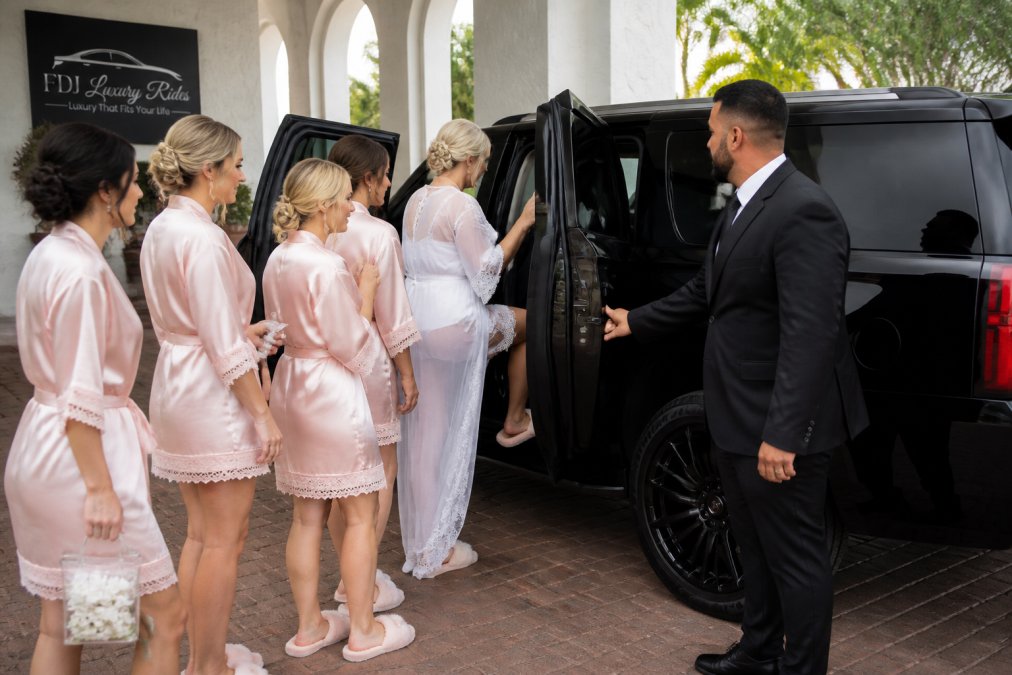
A private car service for bridal parties is a reserved vehicle and dedicated chauffeur assigned to the wedding party for a set block of hours, separate from guest movement. It keeps the couple and their attendants on their own schedule instead of the group’s. This level of logistical precision ensures that your wedding day timeline remains fluid and stress-free, allowing for seamless transitions between photography sessions and the ceremony.
Wedding Transportation Timeline Tips
Booking early is the single biggest factor in getting the vehicles you want. Peak wedding season in Florida runs from October through April, and weekend dates in that window fill first.
A workable timeline:
- 9-12 months out: Reserve your primary vehicles. Lock the date.
- 4-6 months out: Confirm guest count estimates and adjust fleet size.
- 6-8 weeks out: Finalize pickup times and addresses with your venue.
- 1-2 weeks out: Send the driver your final itinerary and contact list.
- Day before: Confirm every driver, vehicle, and pickup time in writing.
Questions to Ask Wedding Transportation Companies
The right questions separate a company that will show up from one that will not. Ask these before you pay a deposit.
- Are your drivers employees or independent contractors?
- Are you fully licensed and commercially insured?
- What is your backup plan if a vehicle breaks down?
- How do you handle a driver calling out sick on my date?
- What is the exact overtime rate and billing increment?
- Is gratuity included in the quote?
- Can I see the specific vehicle I am reserving?
- What happens if my ceremony runs late?
The single most useful question is the backup plan. Any operator can promise reliability; only a company with real fleet depth can deliver it when something goes wrong.
Permitting, Venue Restrictions, and Eco-Friendly Options
Two logistics angles most couples never plan for are venue access rules and environmental impact, and both can be handled with one phone call. This is the part of the planning that separates a smooth arrival from a chauffeur circling the block while your ceremony start time passes.
Venue Access Rules: What to Ask For in Writing
Every venue has a vehicle policy, and most couples never see it until the week of the wedding. Ask your venue coordinator for the policy in writing and pass it to your transportation provider before the day. The policy typically covers four things:
- Drop-off zone. Where vehicles may stop to unload passengers, and whether that zone is shared with other vendors.
- Staging and idling rules. Where vehicles wait between trips, and whether idling is restricted near residences or outdoor ceremony spaces.
- Commercial vehicle access. Whether larger vehicles may use a private drive, a residential street, or a gated entrance, and whether a permit is required.
- Load-in windows. The specific times vehicles may arrive, which often do not match the ceremony start time.
The One-Page Vehicle Access Sheet
Build a single document and give a copy to every driver, the venue coordinator, and your day-of contact. It should include:
- Venue name, street address, and the specific entrance vehicles should use.
- The drop-off zone and the staging area, described in plain language.
- Arrival windows for each vehicle, matched to the ceremony and reception timeline.
- The name and mobile number of the person who can open a gate or move a barrier.
- Any permit number or written approval the venue issued for commercial vehicle access.
Eco-Friendly Options Without the Trade-Off
Hybrid and electric sedans and SUVs are increasingly common in luxury fleets, and they handle the couple’s exit and VIP transfers without any compromise on comfort. The larger the vehicle, the less likely it is to be electric today, so the practical sustainability lever is not the vehicle class, it is how full each vehicle runs.
Venue access rules and fleet composition are both answerable in one email to your venue and one to your provider. Send both before you sign a contract, not the week of the wedding.
Frequently Asked Questions
How far in advance should I book wedding transportation?
For peak wedding season in the Tampa Bay area, book three to six months ahead to secure fleet availability. Popular dates like Saturday evenings in spring and fall fill quickly. If your wedding falls on a holiday weekend or you need multiple vehicles, start even earlier. Booking early also gives you time to confirm venue access rules and finalize your transportation quote without rushing.
What should I look for in a professional transportation contract?
Check that the contract lists your exact pickup times, vehicle types, passenger capacity, and hourly minimums. Confirm the overtime rate, gratuity policy, and cancellation terms before signing. Ask whether the company is fully licensed and commercially insured. A clear contract protects you if plans change and ensures your wedding day logistics run without surprises.
How do I determine the right vehicle type for my wedding party?
Start with your guest count and how many people travel together at each stage. A sedan or SUV works for the couple and a few VIPs. A van handles groups of passengers comfortably. For larger groups moving between ceremony and reception, a larger vehicle keeps everyone together. Match vehicle capacity to your largest single movement, not your total guest list.
How does private transportation improve the wedding day timeline?
A dedicated chauffeur eliminates waiting for rideshare pickups and keeps your schedule on track. Your driver knows the route, arrives early, and stays with your group through each transition. That means no gaps between the ceremony, photos, and reception. Real-time coordination also helps if traffic delays occur, so you arrive relaxed instead of rushed.